

Walk into any tint shop or start browsing online, and you’ll see the same thing.
Ceramic tint is positioned as the “premium” option. Better heat rejection. Better performance. Better everything. It also costs more, sometimes significantly more.
So the obvious question is:
Is ceramic tint actually worth it, or is it just a more expensive version of something basic?
The answer isn’t as simple as yes or no. It depends on what you expect from your car window tint and how you use your car every day.
Let’s break it down properly.
Car Window Tint: What You’re Actually Paying For
Before getting into ceramic specifically, it helps to understand what window tint is doing in the first place.
Most people think tint is about darkness.
It’s not.
Tint is about controlling what comes through the glass:
- heat
- UV radiation
- glare
Different films handle these things differently. That’s where the price difference comes from.
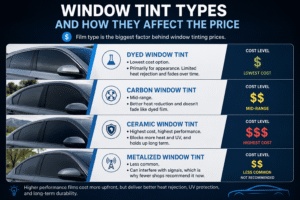
Basic tint (often dyed film) mainly reduces brightness. It makes the car look darker, and it helps a bit with glare. But when it comes to heat, it’s limited.
Ceramic tint is built differently. Instead of just darkening the glass, it’s designed to block heat more effectively, even at lighter shades.
That’s the real distinction.
What Makes Ceramic Tint Different
Ceramic tint uses non-metallic, non-dyed particles that target heat more directly.
That matters for a few reasons.
First, it doesn’t rely on darkness to perform. You can have a lighter tint that still reduces a significant amount of heat.
Second, it doesn’t interfere with signals. Some older metallic films could affect GPS, phone signal, or radio. Ceramic avoids that entirely.
But the main thing people notice is simpler than all of that.
The car feels different.
Not dramatically colder, but more stable. Less of that constant heat creeping in through the glass.
Where Ceramic Tint Actually Makes a Difference
This is where the conversation becomes more practical.
If you drive occasionally, short distances, mostly in mild conditions, the difference between standard tint and ceramic may not feel huge.
But if you:
- drive daily
- sit in traffic often
- park outdoors
- deal with strong sun regularly
then the difference becomes more obvious.
Ceramic tint reduces how much heat builds up in the first place. That means:
- the cabin cools faster
- the AC doesn’t work as hard
- surfaces don’t stay as hot
It’s not about comfort for five minutes. It’s about how the car feels over time.
Car Window Tint: Where People Get Misled
This is where some of the “marketing” perception comes from.
People assume:
darker tint = better performance
That’s not always true.
A dark, low-quality film can still let in a lot of heat. Meanwhile, a lighter ceramic film can outperform it without making the car feel dark or closed in.
That’s why some people get ceramic tint and say it’s worth it, while others feel like nothing changed.
It depends on what they had before and what they expected.
Car Window Tint in Sacramento: Does Ceramic Matter More?
In places with consistent sun, the answer leans more clearly toward yes.
Car Window Tint in Sacramento
Sacramento doesn’t just get hot. It stays bright for long stretches of the day. That steady exposure adds up.
In that kind of environment, the difference between basic film and ceramic film becomes more noticeable over time.
Cars that sit outside regularly or spend time in traffic tend to benefit the most. The cabin doesn’t spike in temperature as aggressively, and it recovers faster once you start driving.
This is where ceramic starts to feel less like an upgrade and more like a practical choice.
Window Tinting in Sacramento: Why Film Quality Shows Faster
Window Tinting in Sacramento
Heat exposes weaknesses in tint quickly.
Lower-quality films can:
- fade
- bubble
- lose effectiveness
sometimes within a year or two under constant sun.
Ceramic film tends to hold up better over time. Not because it’s “premium,” but because it’s built to handle heat differently.
When you’re looking into window tinting in Sacramento, this becomes part of the decision. It’s not just about how the tint looks on day one. It’s about how it performs after months of exposure.
Is It Worth the Extra Cost?
This is the part people care about most.
Ceramic tint costs more. That’s not in question.
So the better question is:
What are you getting for that difference?
You’re paying for:
- better heat rejection
- longer-lasting performance
- more flexibility in tint shade
- less strain on your AC over time
If those things matter to you, it’s worth it.
If your main goal is appearance and you don’t deal with much heat or long drives, standard tint might be enough.
Car Window Tint: A Simple Way to Decide
Instead of overthinking it, ask yourself a few straightforward questions.
Do you feel heat coming through the glass while driving?
Do you park outside often?
Do you notice your car takes time to cool down?
If the answer is yes to most of these, ceramic tint will likely make a noticeable difference.
If not, you may not need it.
People don’t start with “ceramic vs standard.” They start with something like auto window tinting near me because something is bothering them. Heat, glare, discomfort.
Ceramic tint becomes relevant once they realize the problem isn’t just brightness. It’s heat entering through the glass.
That’s usually when the upgrade starts making sense.
Car Window Tint: The Long-Term View
This isn’t just about how the car feels this week.
Over time, reduced heat also means:
- less interior wear
- less fading
- less stress on materials
It’s not dramatic, but it’s consistent.
That’s where the value shows up quietly.
Window Tinting in Sacramento: Final Thought
Car Window Tint and Window Tinting in Sacramento
Ceramic tint isn’t magic. It won’t turn your car into a refrigerator.
But it does solve a specific problem better than standard film:
heat coming through the glass
In a place where sun exposure is consistent, that matters more than people expect.
So is it worth it?
If comfort, long-term performance, and heat reduction matter to you, yes.
If you just want darker windows and don’t care about the rest, probably not.
Final Thought
Ceramic tint isn’t just marketing, but it’s also not necessary for everyone.
It’s a tool.
Used in the right situation, it makes a real difference. Used in the wrong one, it feels like overkill.
The key is understanding what you actually want your car window tint to do before choosing the film.